
Madina Mujadidi
We have definitely heard all around the news, social media as well as in public spaces with posters up requiring everyone to wear a face mask in certain settings. At least that is the case in France and Belgium.
While a face mask, defined as “a mask or protective covering for the face or part of the face”, is lawful in these two countries, the niqab, which also covers most of the face but the eyes, is deemed unlawful. Why is this the case?
Before the COVID-19 pandemic, in France, the Law of 2010-1192 prohibited the concealment of the face in public space including the burqa, niqab, helmet and masks. This ban from the outset seemed to target every sort of facial covering regardless of the user’s background. In June 2009, President Nicolas Sarkozy stated face veils were ‘not welcome’ within France indicating hints that the law would unevenly target Muslim individuals.
There is a deep concerning escalation of Islamophobia in France with very little international attention given. This is partly by the words and actions of French politicians, including President Emmanuel Macron, calling the French nation to stand up against “underground Islamism that corrupts the children of France”.
The public debate over the law have been to protect women from being forced to cover their faces against their will and so uphold France’s secular values, as well as for security and nationalistic reasons too. Arguments for the ban further allege that the ‘forced’ wear of face coverings is sexist and that these women should assimilate to French social norms. The association of the niqab with oppression itself indicates the failure to recognise it is more than just a cloth that covers a face.
The women who wear niqabs argue it encroaches on their individual freedoms as they mostly claim are willingly wearing it for religious reasons. Modesty in Islam, in terms of dressing, has to accord to a particular standard and some interpret this differently, meaning some women may define modesty to cover their face too. Disallowing one to practice their religion is harming the right of women to manifest their religious beliefs.
But even if a woman chooses to cover themselves, why should this be a topic of discussion? Muslim women are more than just the clothes they wear. They are still individuals living a normal life like everyone else. They are in school learning, at work as lawyers, doctors and teachers.
The ban is slightly different in Belgium whereby the head covering, ‘hijab’, has been banned in Belgian universities after the constitutional court’s decision in July 2020. The ban led thousands of demonstrators take the streets, including non-hijab wearers to stand in solidarity with Muslim women.
On social media, the hashtag, #HijabisFightBack, went viral by activists highlighting the sexist and discriminatory impact this ban would have.
In an interview with Vice, a feminist author Fatima-Zohra Ait El Maâti stated “it is funny, though, to think that at the age of 24, there are people who think about liberating me – and especially, who think they can do it better than I can.”
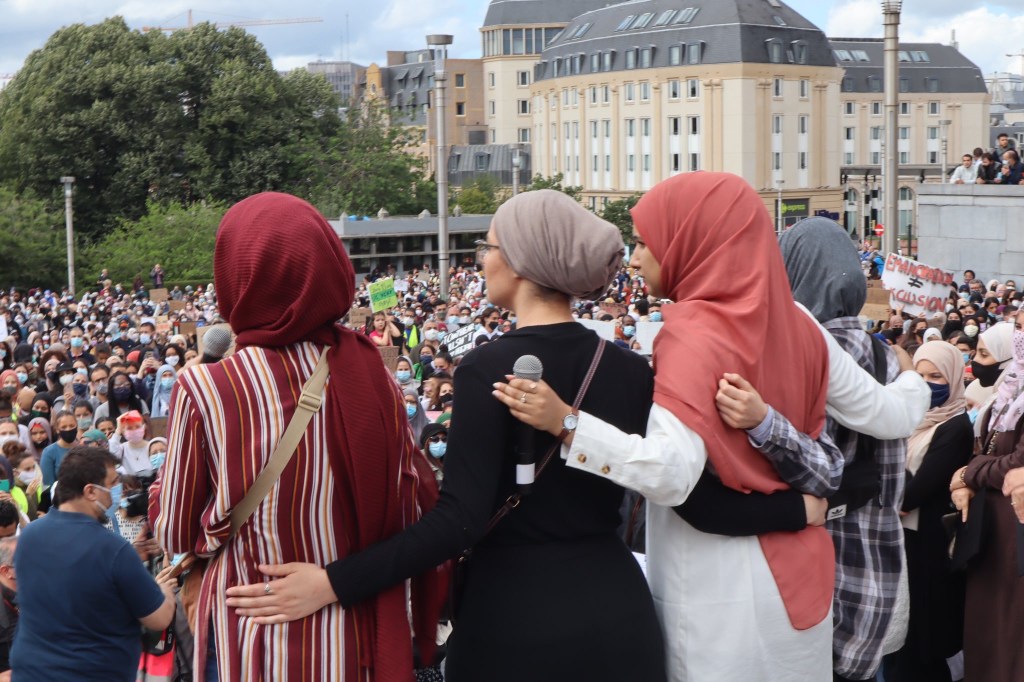
This ban has made women essentially being forced to pick between their faith and education. Muslim students created petitions to change this decision which negates the equal treatment of people in terms of religion.
France and Belgium’s bans have only fuelled further the rising anti-Muslim and anti-immigrant rhetoric in Europe. These measures vary to each neighbouring country but have their own harmful impact – one, excluding Muslim women from higher education and so from future career prospects in foresight; two, restricting Muslim women from accessing the public sphere.
The debate on the hijab and niqab is an on-going one that does not end. It is spoken about for a while then comes to halt and starts all over again. Secular states like to handle this situation themselves and talk on behalf of Muslim women to try ‘emancipate’ them from their so-called oppression. It is by no means secular liberalism guarantees religious freedom, but rather is the opposite.
Activists have called for increased dialogue with Muslim women to tackle this issue. The question on the niqab and hijab is a question of the body, the same way as feminists and LGBTQ+ supporters calls ‘my body, my choice’. The same enthusiasm given to other minorities and their pledges for equality should be given equally to Muslim women too. The normalisation of Muslim women covering themselves however they wish and still living an ordinary life needs to be echoed and accepted.
The same way everyone is wearing a face mask to protect themselves from coronavirus, is that any different from a niqab? Are all individuals now succumbed to a form of oppression?
Sign this petition to support Muslim women being barred from higher education: https://www.change.org/p/belgian-constitutional-court-stop-the-banning-of-hijabs-in-higher-education-in-belgium
The views expressed in this entry are the author’s own and may not reflect those of other authors for Diaspora Writes.


Such an interesting read!!!
LikeLike